The Tabernacle and Its Services: Meaning, Symbolism, and Biblical Importance
Part 1:
The command was communicated to Moses while in the mount with God: “Let them make Me a sanctuary, that I may dwell among them.” Exodus 25:8. Full directions were given for the construction of the tabernacle. By their apostasy, the Israelites forfeited the blessing of the divine presence, and for a time, it became impossible to erect a sanctuary for God among them. But after they were once again taken into favor with Heaven, the great leader proceeded to execute the divine command.
Chosen men were specially endowed by God with skill and wisdom for the construction of the sacred building. God Himself gave Moses the plan for that structure, with particular directions as to its size and form, the materials to be used, and every article of furniture it was to contain. The holy places made with hands were to be “copies of the things in the heavens,” “but the heavenly things themselves with better sacrifices than these.” For Christ has not entered the holy places made with hands, which are figures of the true, but into heaven itself, now to appear in the presence of God for us.” Hebrews 9:23-24. They were a miniature representation of the heavenly temple, where Christ, our great High Priest, after offering His life as a sacrifice, was to minister on behalf of sinners. God presented to Moses a view of the heavenly sanctuary on the mount and commanded him to make all things according to the pattern shown to him. All these directions were carefully recorded by Moses, who communicated them to the leaders of the people.
For the construction of the sanctuary, extensive and costly preparations were required, involving a large quantity of the finest and most valuable materials. However, the Lord only accepted freewill offerings. “Speak to the children of Israel, that they bring Me an offering. From everyone who gives it willingly with his heart you shall take My offering.” Exodus 25:2. This divine command was reiterated by Moses to the congregation. A genuine devotion to God and a spirit of sacrifice were the essential conditions for creating a dwelling place for the Most High.
The people responded in unison. “Then everyone came whose heart was stirred, and everyone whose spirit was willing, and they brought the Lord’s offering for the work of the tabernacle of meeting, for all its service, and for the holy garments. They came, both men and women, as many as had a willing heart, and brought earrings and nose rings, rings and necklaces, all jewelry of gold, that is, every man who made an offering of gold to the Lord.” Exodus 35:21-22. “And every man with whom was found blue, and purple, and scarlet, and fine linen, and goats’ hair, and rams’ skins dyed red, and badger skins, brought them. Everyone that did offer an offering of silver and brass brought the Lord’s offering: and every man, with whom was found acacia wood for any work of the service, brought it.” Exodus 35:23-24.
“All the women who were gifted artisans spun yarn with their hands, and brought what they had spun, of blue, purple, and scarlet, and fine linen. And all the women whose hearts stirred with wisdom spun yarn of goats’ hair.” Exodus 35:25-26.
“And the rulers brought the onyx stones, and the stones to be set, for the ephod, and for the breastplate; and the spice, and the oil; for the light, and for the anointing oil, and for the sweet incense.” Exodus 35:27-28.
While the construction of the sanctuary was underway, the people—men, women, and children of all ages—continued to bring their offerings. Those in charge of the work soon realized they had more than enough materials, even beyond what was needed. As a result, Moses proclaimed throughout the camp, “Let neither man nor woman make any more work for the offering of the sanctuary.” Exodus 36:6.
“So the people were restrained from bringing.” This passage highlights the murmurings of the Israelites and the visitations of God’s judgments because of their sins, serving as a warning to future generations. Yet, their devotion, zeal, and liberality stand as an example worthy of imitation. All who love the worship of God and value the blessing of His sacred presence will demonstrate the same spirit of sacrifice when preparing a house where He may meet with them. They will seek to offer to the Lord the very best they possess. A house built for God should not be left in debt, for this dishonors Him. A sufficient amount to complete the work should be freely given so that the workmen may be able to say, as the builders of the tabernacle did, “Bring no more offerings.” Exodus 36:6.
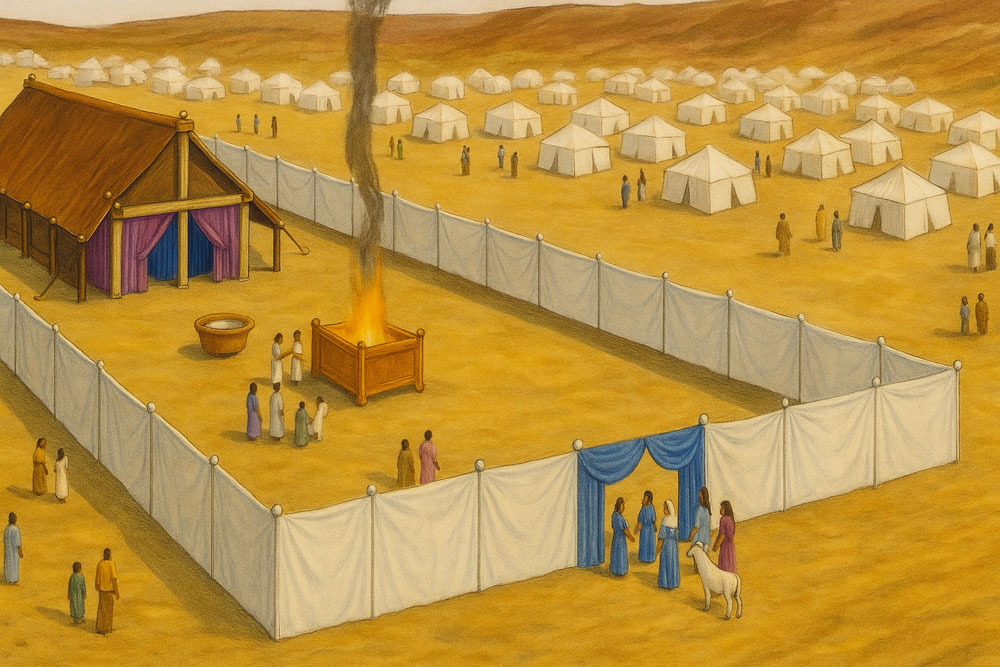
The tabernacle was designed to be portable, able to be taken apart and carried with the Israelites on all their journeys. Therefore, it was relatively small—measuring no more than fifty-five feet in length, and eighteen feet in both breadth and height. Yet, it was a magnificent structure. The wood used for the building and its furniture was that of the acacia tree, which was less prone to decay than any other wood available at Sinai.
The walls consisted of upright boards, set in silver sockets, and held firm by pillars and connecting bars; all were overlaid with gold, giving the building the appearance of solid gold. The roof was made up of four sets of curtains. The innermost was of “fine woven linen and blue, purple, and scarlet thread; with artistic designs of cherubim you shall weave them.” Exodus 26:1. The other three were made of goats’ hair, rams’ skins dyed red, and badger skins, arranged to provide complete protection.
The building was divided into two apartments by a rich and beautiful curtain, or veil, suspended from gold-plated pillars. A similar veil closed the entrance to the first apartment. These veils, like the inner covering that formed the ceiling, were made of the most magnificent colors—blue, purple, and scarlet—beautifully arranged, while cherubim were woven into them with threads of gold and silver, symbolizing the angelic host connected with the work of the heavenly sanctuary. These cherubim also represented the ministering spirits who serve the people of God on earth.
The sacred tent was enclosed in an open space called the court, which was surrounded by hangings of fine linen, suspended from brass pillars. The entrance to this enclosure was at the eastern end and was closed by curtains made of costly material and beautiful workmanship, although not as fine as those of the sanctuary. The hangings of the court were only about half as high as the walls of the tabernacle, so the building could be easily seen by the people outside. Inside the court, nearest the entrance, stood the brazen altar of burnt offering. On this altar, all the sacrifices made by fire unto the Lord were consumed, and its horns were sprinkled with the atoning blood.
Between the altar and the door of the tabernacle was the laver, also made of brass, crafted from the mirrors that had been freely offered by the women of Israel. The priests were to wash their hands and feet at the laver whenever they entered the sacred rooms or approached the altar to offer a burnt offering to the Lord. In the first apartment, or holy place, stood the table of showbread, the candlestick (lampstand), and the altar of incense. The table of showbread was positioned on the north side, overlaid with pure gold and adorned with an ornamental crown. Each Sabbath, the priests placed twelve loaves on this table, arranged in two stacks, and sprinkled with frankincense. The loaves that were removed, considered holy, were to be eaten by the priests. On the south side stood the seven-branched candlestick with its seven lamps. Its branches were delicately shaped with beautifully crafted flowers resembling lilies, and the entire lampstand was made from one solid piece of gold. Since the tabernacle had no windows, the lamps were never completely extinguished, providing light both day and night.
Just before the veil that separated the holy place from the most holy place, which contained the immediate presence of God, stood the golden altar of incense. The priest was to burn incense on this altar every morning and evening. Its horns were touched with the blood of the sin offering, and it was sprinkled with blood on the great Day of Atonement.
The fire upon this altar was kindled by God Himself and was sacredly maintained. Day and night, the holy incense filled the air with its fragrance, diffusing throughout the sacred rooms and extending far beyond the tabernacle.
Beyond the inner veil was the holy of holies, the place where the symbolic service of atonement and intercession took place, and where heaven and earth were linked. In this apartment stood the ark, a chest made of acacia wood and overlaid with gold both inside and out, with a crown of gold surrounding its top. It was designed as a depository for the stone tablets on which God Himself had written the Ten Commandments. As such, it was known as the ark of God’s testament or the ark of the covenant, since the Ten Commandments were the foundation of the covenant between God and Israel.
The cover of the sacred chest was called the mercy seat. This was made from one solid piece of gold and was adorned with golden cherubim, one at each end. One wing of each cherub was stretched upward, while the other wing was folded over the body, symbolizing reverence and humility. “Thus were their faces. Their wings stretched upward; two wings of each one touched one another, and two covered their bodies.” Ezekiel 1:11. The positioning of the cherubim, with their faces turned toward each other and looking downward reverently toward the ark, represented the respect the heavenly host have for the law of God and their interest in the plan of redemption.
Above the mercy seat was the Shekinah, the visible manifestation of God’s presence. From between the cherubim, God revealed His will. At times, divine messages were communicated to the high priest through a voice from the cloud. Sometimes a light would fall upon the cherub on the right to signify approval, or a shadow or cloud would rest on the cherub on the left to signify disapproval.
The law of God, enshrined within the ark, served as the supreme standard of righteousness and judgment. That law pronounced death upon the transgressor; yet above the law was the mercy seat, where the presence of God was revealed. From this place, through the power of the atonement, pardon was extended to the repentant sinner. In this way, Christ’s work of redemption, represented by the sanctuary service, fulfills the words: “Mercy and truth have met together; Righteousness and peace have kissed.” Psalm 85:10.
No words can fully capture the splendor of the sanctuary’s interior—the gold-plated walls reflecting the glow of the golden lampstand, the radiant colors of the richly embroidered curtains adorned with shining angels, the table, and the altar of incense, glistening with gold. Beyond the second veil stood the sacred ark, with its mysterious cherubim, and above it, the holy Shekinah—the visible manifestation of Jehovah’s presence—all but a faint reflection of the magnificent temple of God in heaven, the central place of His work for humanity’s redemption.