Journey from the Red Sea to Mount Sinai: God's Guidance and Provision in the Wilderness
Part 3:
A new danger soon loomed over them. Because of their ceaseless murmuring against Him, the Lord allowed their enemies to assail them. The Amalekites, a fierce and warlike tribe native to the region, emerged and struck down those who, faint and weary, lagged behind. Aware that the people were unprepared for battle, Moses directed Joshua to select a body of soldiers from the various tribes and lead them into combat the following day, while he himself took position on a nearby elevation with the rod of God in hand. Accordingly, the next day Joshua and his men attacked the foe, as Moses, Aaron, and Hur remained on a hill overlooking the battlefield. With his arms stretched toward heaven and clutching the rod of God in his right hand, Moses prayed for the victory of Israel’s armies. As the battle wore on, it became evident that as long as his hands remained raised, Israel prevailed; but whenever they drooped, the enemy advanced. When Moses grew weary, Aaron and Hur supported his hands until sunset, at which time the enemy was driven away.
Aaron and Hur, by sustaining Moses’ outstretched hands, demonstrated to the people their duty to support him in his arduous labor as he received God’s message to deliver to them. Moses’ act was equally significant, revealing that God held their destiny in His hands; as long as they placed their trust in Him, He would fight for them and subdue their enemies, but if they released their hold on Him and relied on their own strength, they would become even weaker than those without the knowledge of God, and their foes would prevail.
As the Hebrews triumphed while Moses’ hands reached heaven in intercession on their behalf, so too does the Israel of God prevail when they, by faith, grasp the strength of their mighty Helper. Yet divine strength must be combined with human effort. Moses did not assume that God would overcome their enemies while Israel remained inactive. While the great leader pleaded with the Lord, Joshua and his brave followers exerted their utmost efforts to repulse the adversaries of both Israel and God.
Following the defeat of the Amalekites, God instructed Moses: “Write this for a memorial in the book and recount it in the hearing of Joshua, that I will utterly blot out the remembrance of Amalek from under heaven.” Exodus 17:14. Immediately before his death, the great leader delivered to his people the solemn charge: “Remember what Amalek did to you on the way as you were coming out of Egypt, how he met you on the way and attacked your rear ranks, all the stragglers at your rear, when you were tired and weary; and he did not fear God. Therefore it shall be, when the Lord your God has given you rest from your enemies all around, in the land which the Lord your God is giving you to possess as an inheritance, that you will blot out the remembrance of Amalek from under heaven. You shall not forget.” Deuteronomy 25:17-19.
Regarding this wicked nation, the Lord declared: ‘Because the Lord has sworn: the Lord will have war with Amalek from generation to generation.’” Exodus 17:16. The Amalekites were fully aware of God’s character and sovereignty; yet instead of fearing Him, they boldly set themselves against His power. The wonders wrought by Moses before the Egyptians became objects of mockery for the Amalekites, and the fears of the surrounding nations were likewise ridiculed. They swore by their gods to destroy the Hebrews so that none should escape, boasting that the God of Israel would be powerless to resist them.
They had neither been injured nor threatened by the Israelites, and their assault was entirely unprovoked. Their purpose was to manifest their hatred and defiance toward God by seeking the destruction of His people. The Amalekites had long behaved with arrogance, and although their crimes cried out for divine vengeance, God’s mercy had still called them to repentance; yet when the men of Amalek attacked the weary and defenseless ranks of Israel, they sealed the doom of their nation. Truly, the care of God extends even over the weakest of His children.
Heaven marks every act of cruelty or oppression committed against them. For all who love and fear the Lord, His hand extends as a protective shield; therefore, men must take care not to strike that hand, for it wields the sword of justice.
Not far from where the Israelites had pitched their camp was the home of Jethro, Moses’ father-in-law. Having heard of the Hebrews’ deliverance, Jethro set out to visit them and restore Moses’ wife and two sons. The great leader was informed by messengers of their approach and went out with joy to greet them; after the initial salutations, he escorted them to his tent. Though he had sent his family away when he embarked on the perilous task of leading Israel from Egypt, he now rejoiced in once again enjoying the relief and comfort of their presence. Moses recounted to Jethro the marvelous dealings of God with Israel, and the patriarch rejoiced and blessed the Lord; together with Moses and the elders, he united in offering sacrifice and holding a solemn feast in commemoration of God’s mercy.
While Jethro remained in the camp, he soon perceived the immense burdens resting upon Moses. The task of maintaining order and discipline among such a vast, untrained, and uninformed multitude was truly staggering. Moses, as their recognized leader and judge, was charged not only with the general welfare and duties of the people but also with resolving the disputes among them. He allowed this arrangement so that he might instruct them, declaring, “And you shall teach them the statutes and the laws, and show them the way in which they must walk and the work they must do.” Exodus 18:20. However, Jethro reproved him, saying, “Both you and these people who are with you will surely wear yourselves out. For this thing is too much for you; you are not able to perform it by yourself.” Exodus 18:18. He further advised Moses to appoint capable men as leaders over thousands, hundreds, fifties, and tens—men who were “able men, such as fear God, men of truth, hating covetousness.” Exodus 18:21.
These men were to judge all matters of minor consequence, while the more difficult and important cases would still be brought before Moses, who, Jethro said, should, “Stand before God for the people, so that you may bring the difficulties to God. And you shall teach them the statutes and the laws, and show them the way in which they must walk and the work they must do.” Exodus 18:19-20. Moses accepted this counsel, which not only alleviated his burdens but also established a more orderly system among the people. The Lord had highly exalted Moses and performed mighty works through his hand; yet being chosen to instruct others did not lead him to assume that he himself required no guidance. The appointed leader of Israel welcomed the counsel of the godly priest of Midian with gladness and embraced his proposal as a wise plan.
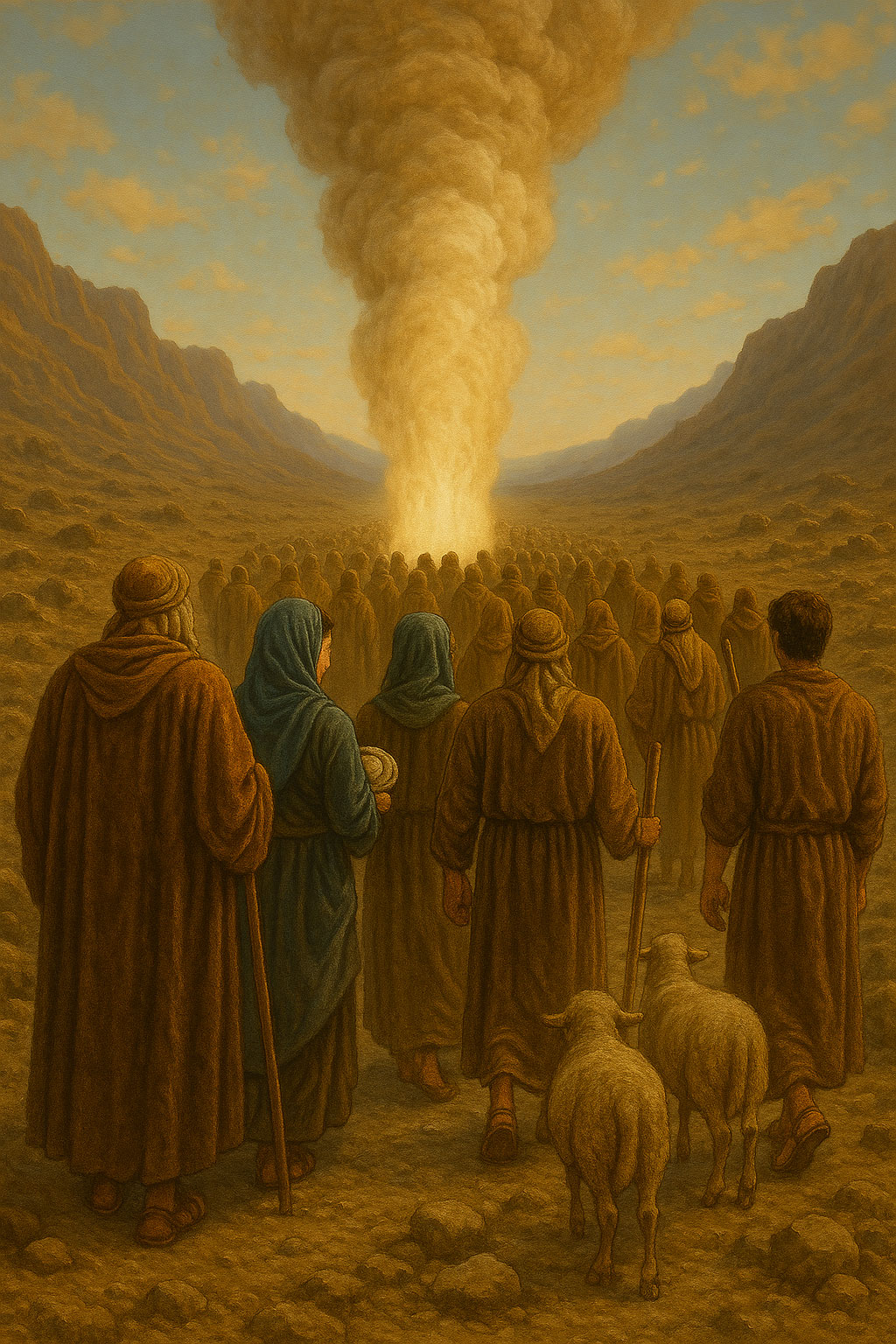
From Rephidim the people resumed their journey, following the movement of the cloudy pillar. Their path had taken them across desolate plains, over steep ascents, and through rugged defiles. Many times, as they traversed the sandy wastes, they encountered rugged mountains—towering bulwarks arrayed directly before them, seemingly barring all further progress. However, as they drew near, occasional openings appeared in the mountain wall, revealing yet another plain beyond. They were led through one of the deep, gravelly passes—a scene both grand and impressive. Between rocky cliffs rising hundreds of feet on either side, the host of Israel, together with their flocks and herds, flowed in a living tide as far as the eye could see.
Now, in solemn majesty, Mount Sinai rose before them with its massive front crowned by the cloudy pillar, while the people pitched their tents on the plain below. This was to be their home for nearly a year. At night the pillar of fire assured them of divine protection, and while they slept, the “bread of heaven” fell gently upon the camp.
At dawn the dark ridges of the mountains were gilded by the sun, its golden rays piercing deep gorges like beams of mercy from the throne of God, offering solace to the weary travelers. In every direction, vast and rugged heights stood in solitary grandeur, speaking of eternal endurance and majesty, and instilling a profound sense of awe. Man was made acutely aware of his own ignorance and frailty in the presence of Him who “weighed the mountains in scales, and the hills in a balance.” Isaiah 40:12.
At this sacred place, Israel was to receive the most extraordinary revelation ever granted by God to mankind. Here the Lord gathered His people to impress upon them the sanctity of His commandments by declaring His holy law in His own voice. Great and radical transformations were destined for them; the corrupting influences of long-continued servitude and idolatry had marred their habits and character, and God was working to elevate them to a higher moral standard by imparting a true knowledge of Himself.